How Georgia's Humid Summers Affect Concrete Curing in Dallas GA
Ask any experienced concrete contractor in Dallas, GA what their biggest summer challenge is, and they’ll say the same thing: keeping the concrete from drying too fast. Georgia’s humid subtropical climate creates a paradox — the humidity feels like it would keep concrete moist, but the combination of intense heat and direct sun drives moisture out of a freshly poured slab faster than the chemical curing reaction can use it. The result, on an unmanaged summer pour, is plastic shrinkage cracking and a weaker surface that didn’t form properly.
In this post, we cover: what concrete curing actually requires, how Georgia’s summer conditions interfere with it, what experienced contractors do differently, and what homeowners in Dallas, GA should ask about before scheduling a summer pour.
Summer Concrete in Dallas, GA — Done Right
Dallas Concrete uses season-appropriate curing techniques on every project. Call (888) 376-0955 for a free estimate.
What Concrete Curing Actually Requires
Concrete doesn’t “dry” — it cures through a chemical reaction called hydration. Water molecules react with cement particles to form calcium silicate hydrate crystals, which give concrete its strength. This reaction requires a sustained supply of moisture and moderate temperatures — ideally 50–80°F — to proceed at the rate needed for full strength development.
Concrete reaches about 70% of its 28-day design strength in the first 7 days. That first week is the most critical window. If moisture escapes the slab too quickly during those 7 days — through evaporation driven by heat, wind, or low humidity — the hydration reaction slows or stops before the concrete achieves its intended strength.
Why Georgia’s Summer Heat Is Specifically Challenging
Dallas, GA’s July average high of 87°F, combined with direct sun and concrete’s naturally low albedo (it absorbs rather than reflects heat), means slab surface temperatures on a mid-summer pour day can reach 120–130°F. At those temperatures, the rate of surface evaporation dramatically exceeds the rate at which the hydration reaction can consume moisture.
The homeowner impact isn’t always visible immediately. A summer slab poured without proper curing precautions often looks fine for 1–3 years. The weakness shows up later: the surface layer, which didn’t fully hydrate, begins to dust, scale, or spall — crumbling under vehicle traffic and freeze-thaw cycles in ways that a properly cured slab wouldn’t. By the time homeowners in Savannah Lakes or Riverwood notice the deterioration, the damage is locked into the concrete from day one.
Types of Summer Curing Problems in Dallas GA
Plastic shrinkage cracking: Fine cracks that appear on the surface before the concrete even fully sets. Caused by moisture evaporating faster than bleed water rises to replace it. These cracks are difficult or impossible to repair invisibly once formed.
Surface scaling: The top 1/8 to 1/4 inch of the slab weakens from incomplete hydration and eventually delaminates under traffic and freeze-thaw cycles. Common on Dallas, GA driveways poured in peak summer without curing compound.
Reduced compressive strength: Slabs that cured too dry may test 15–25% below their design strength — not always enough to cause obvious failure, but enough to shorten service life and increase crack susceptibility.
Map cracking (crazing): Fine, irregular crack patterns across the surface that resemble a road map. A classic sign of improper summer curing — the surface hardened too fast while the interior was still setting, creating tension cracks from differential shrinkage.
Practical Uses: What Quality Contractors Do Differently in Summer
- Early morning scheduling: Experienced Dallas concrete contractors schedule summer pours to begin at 5–6am and target finishing before noon. This avoids the peak afternoon surface temperatures that drive rapid evaporation.
- Evaporation retarder: A monomolecular film spray applied to the surface immediately after screeding slows evaporation without affecting the final finish. Adds a modest cost but meaningfully improves curing outcomes in heat above 85°F.
- Curing compound: A liquid compound sprayed on immediately after finishing seals the surface and prevents moisture from escaping during the critical first 24–72 hours. This is the single most important summer curing tool.
- Wet burlap and polyethylene covering: For maximum curing quality, the finished slab is covered with wet burlap and a polyethylene sheet for 7 days, keeping the concrete moist throughout the early hydration window.
- Concrete mix adjustments: Reducing the water-cement ratio, adding fly ash, or using a Type II cement with lower heat of hydration helps manage the temperature within the slab itself during hot-weather pours.
- Wind protection: Wind accelerates evaporation as aggressively as heat. Windbreaks on the exposed sides of a pour site are part of good hot-weather concrete practice.
Summer Concrete Projects in Paulding County Done Right
Dallas Concrete uses proper hot-weather curing on every summer project. Serving Dallas, Hiram, Douglasville, and Paulding County. Call (888) 376-0955.
How Homeowners in Dallas GA Can Assess Summer Curing Practices
When vetting a contractor for a summer concrete project in Dallas, ask these specific questions:
“What time do you start the pour?” Correct answer: pre-dawn or early morning, targeting completion before noon. A contractor who says “we start at 8am when the crew arrives” may not be adapting to Georgia’s summer conditions.
“Do you use curing compound or wet curing?” Correct answer: yes, one or both. “We just let it cure” is not an acceptable answer for a summer pour in Paulding County.
“What’s your process when temperatures are above 90°F?” A contractor who has a specific protocol for hot-weather concrete has experience managing it. Vague answers suggest they don’t adjust their process for conditions.
See our seasonal guide for concrete in Dallas, GA for how summer compares to fall and spring for scheduling decisions.
Frequently Asked Questions
Does humidity in Georgia actually help concrete cure?
Paradoxically, yes and no. High relative humidity reduces the rate of surface evaporation compared to a hot, dry climate — which is one reason Georgia concrete isn’t as prone to plastic shrinkage cracking as arid climates. However, Georgia’s summer combines high humidity with intense heat and direct solar radiation, and the radiant heat effect on the slab surface still drives rapid evaporation. The net effect is still unfavorable for curing compared to spring and fall conditions.
How do I know if my existing concrete was improperly cured in summer?
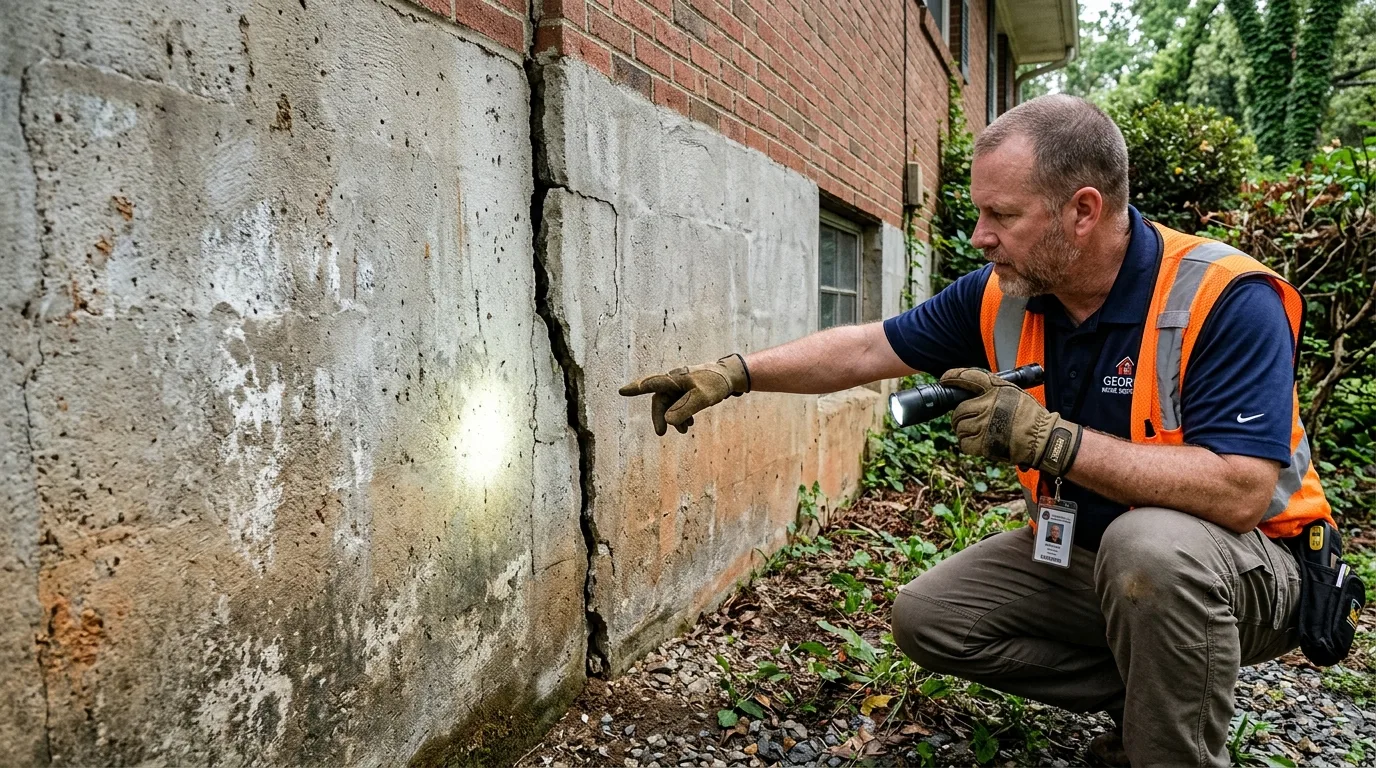
Look for: fine surface cracking that appeared within the first few weeks (plastic shrinkage cracks), surface scaling or dusting (the top layer coming away), and crazing patterns (irregular fine cracks across the surface). These are distinct from the settlement cracks and wider fractures caused by Georgia red clay movement. If you’re unsure, Dallas Concrete offers free assessments — we can tell you whether damage originated from curing issues or soil conditions. See our concrete repair services for repair options.
Should I avoid concrete work entirely in July and August in Dallas GA?
Not necessarily — but summer concrete requires an experienced crew with the right process. Plain driveways and slabs are feasible in summer when proper protocols are followed. Decorative stamped concrete is significantly harder to execute well in July and August and is better deferred to fall when temperatures allow a longer working window. See our stamped concrete guide for Paulding County for why fall is the preferred stamped season.
Dallas Concrete — Hot Weather Concrete Expertise in Paulding County
We manage curing properly in every season. Call (888) 376-0955 for a free estimate on your Dallas, GA concrete project.
Related: