Concrete on Georgia Red Clay: What Dallas GA Homeowners Should Know
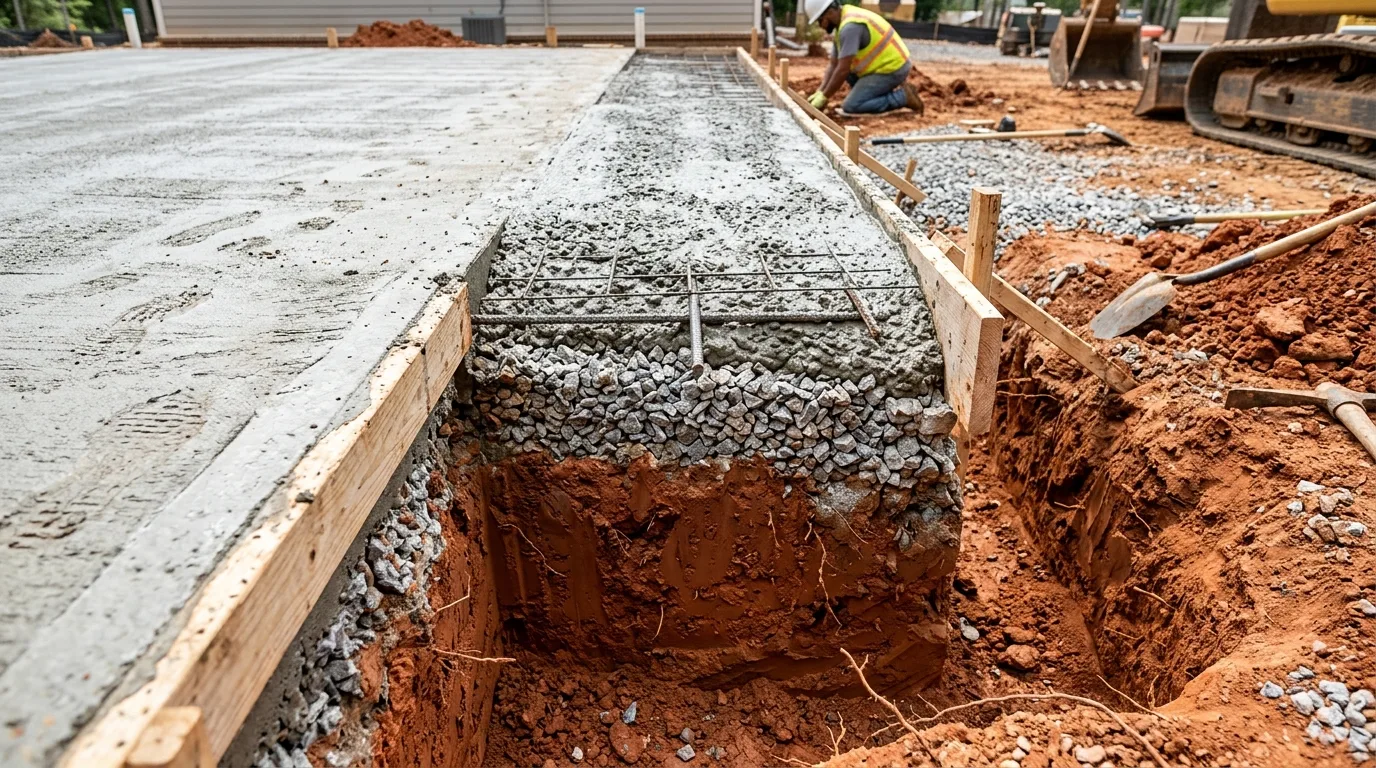
Georgia red clay is the defining soil condition for concrete work in Dallas, GA — and most homeowners don’t fully understand what it means for their driveway or patio until they’re dealing with cracked concrete and uneven slabs. This guide explains exactly how Paulding County’s expansive clay soil interacts with concrete, what that means for installation, and what questions to ask your contractor before any slab is poured.
In this post, we cover: what makes Georgia red clay different, how it causes concrete to crack and settle, what base preparation is required, and how to tell if your concrete damage was caused by soil movement.
Concrete Built for Georgia Red Clay in Dallas, GA
Dallas Concrete installs every slab with proper base prep for Paulding County's soil. Call (888) 376-0955 for a free estimate.
What Georgia Red Clay Actually Is
The iron-oxide-rich soil that gives Paulding County its characteristic reddish color is an ultisol — a highly weathered clay soil type. The red color comes from iron oxide compounds (essentially rust) that have accumulated over millions of years of leaching. This soil is classified as an expansive clay, meaning its volume changes significantly with moisture content — a property that makes it particularly challenging for concrete installations.
Across Dallas, GA — from the established neighborhoods near Pickett’s Mill Battlefield to the newer communities of Seven Hills and Savannah Lakes — this soil sits beneath virtually every residential slab in the area. It’s not unusual; it’s the universal condition for concrete work in northwest Georgia.
How Red Clay Causes Concrete to Crack and Settle
The mechanism is straightforward: expansive clay swells when it absorbs water and shrinks when it dries. In Paulding County, this cycle plays out every year — Georgia’s spring and early summer rains saturate the ground, the clay swells, and the concrete above it shifts. Then Georgia’s dry late summer draws moisture out of the clay, which contracts and pulls away from the slab above, leaving voids. The concrete flexes over these voids under vehicle loads, and cracks develop.
The soil doesn’t have to move dramatically to cause damage. Even minor seasonal movement — fractions of an inch — repeated over 10–15 years creates cumulative stress that eventually exceeds the concrete’s tensile strength. Driveways poured directly on native clay without a stabilizing gravel base experience this failure cycle faster and more severely than those with proper sub-base preparation.
Types of Damage That Red Clay Causes to Concrete
Settlement cracks: Sections sink as voids form beneath the slab from clay shrinkage or compaction under load. These create height differentials between adjacent sections that become trip hazards.
Heaving cracks: Clay expansion pushes sections upward, typically at control joints or weak points in the slab. Visible in Dallas, GA driveways near buried stump or construction debris decomposition.
Lateral expansion cracks: Clay expanding sideways against the edges of a slab can push sections inward, causing cracking along the slab’s center.
Surface spalling from moisture cycling: Water absorbed through surface cracks gets into the concrete matrix, freezes during Dallas’s occasional winter cold snaps, and expands — accelerating crack propagation. This is the combined clay-and-freeze-thaw mechanism that damages driveways in Riverwood and Saddlebrook Farms.
Practical Uses: What Proper Base Preparation Actually Means
- Excavation depth: A concrete driveway in Paulding County requires excavating native clay to 8–10 inches below finished grade — deeper than many standard specs — to accommodate both the gravel base and slab thickness.
- Compacted gravel base: 4–6 inches of clean crushed stone or gravel, compacted in lifts, creates a stable, well-draining foundation that doesn’t swell or shrink with moisture changes the way clay does.
- Edge restraints: Concrete forms should contain the slab edge fully to prevent lateral clay pressure from cracking the perimeter.
- Drainage design: The surface must slope away from structures at minimum 1/8 inch per foot. Downspouts must discharge away from slabs — saturating the clay immediately adjacent to the slab accelerates edge heaving.
- Reinforcement: Rebar or wire mesh doesn’t prevent cracking from clay movement, but it ties the slab together so cracks don’t widen and sections don’t separate dramatically. It’s the difference between hairline cracks that can be sealed and wide gaps that require replacement.
- Control joints: Placed every 8–10 feet in each direction, control joints direct where the slab will crack naturally — protecting the visible surface by concentrating movement at the joints.
Dallas Concrete — Proper Red Clay Base Prep on Every Project
We install 4–6 inches of compacted gravel beneath every slab. Serving Dallas, Hiram, and all of Paulding County. Call (888) 376-0955.
How Dallas GA Homeowners Can Identify Clay-Related Concrete Damage
Several signs indicate that Georgia red clay movement — rather than surface wear or age — is the primary cause of your concrete damage:
Cracking pattern: Wide cracks that run across the full width of a slab section, or cracks that follow a grid pattern between control joints, suggest sub-base movement. Isolated hairline cracks are often just shrinkage.
Settlement differential: If one section of your driveway is noticeably higher or lower than an adjacent section — especially if the difference has grown over time — clay movement is almost certainly involved.
Seasonal change: If cracks look worse in late summer (after Georgia’s dry stretch) or in early spring (after winter moisture), you’re seeing the clay shrink-and-swell cycle directly in your concrete.
Hollow sound: Tap slab sections with a solid object. A hollow sound indicates a void beneath the slab — the clay has pulled away. This is significant: voids are where slab failure accelerates.
Frequently Asked Questions
How do I know if my concrete cracked from clay soil or from another cause?
Clay-movement cracks typically follow a pattern: they cross the slab rather than following a straight line along the surface, they’re accompanied by settlement differentials between sections, and they worsen in late summer when clay is driest. Shrinkage cracks from improper curing are typically fine, surface-level, and appear within the first few weeks. Freeze-thaw spalling looks like surface delamination rather than through-cracks. For a definitive assessment, contact Dallas Concrete for a free evaluation.
Can existing cracked concrete from clay movement be repaired?
Yes, in many cases. If the slab is otherwise structurally sound, crack filling and joint sealing can extend its life significantly. Full resurfacing is appropriate when cracks are numerous but not through the full slab depth. Replacement is needed when sections have settled more than an inch, cracking is through the full depth across large areas, or voids beneath the slab are extensive. See our concrete repair vs. replacement guide for the decision framework.
Does a gravel base prevent red clay from damaging concrete in Dallas GA?
A proper compacted gravel base dramatically reduces clay movement damage but doesn’t eliminate it entirely. The gravel base provides a stable, well-draining foundation that absorbs the minor movement clay produces before it reaches the concrete above. It also improves drainage beneath the slab, reducing soil saturation that drives expansion. Properly installed concrete slabs on a 4–6 inch compacted gravel base in Paulding County routinely last 30–40 years. See our concrete driveway services for how we spec every driveway project.
Protect Your Concrete from Georgia Red Clay
Dallas Concrete installs proper sub-base on every project in Paulding County. Call (888) 376-0955 for a free written estimate.
Related: