Repair vs Replace Your Concrete Driveway in Dallas GA
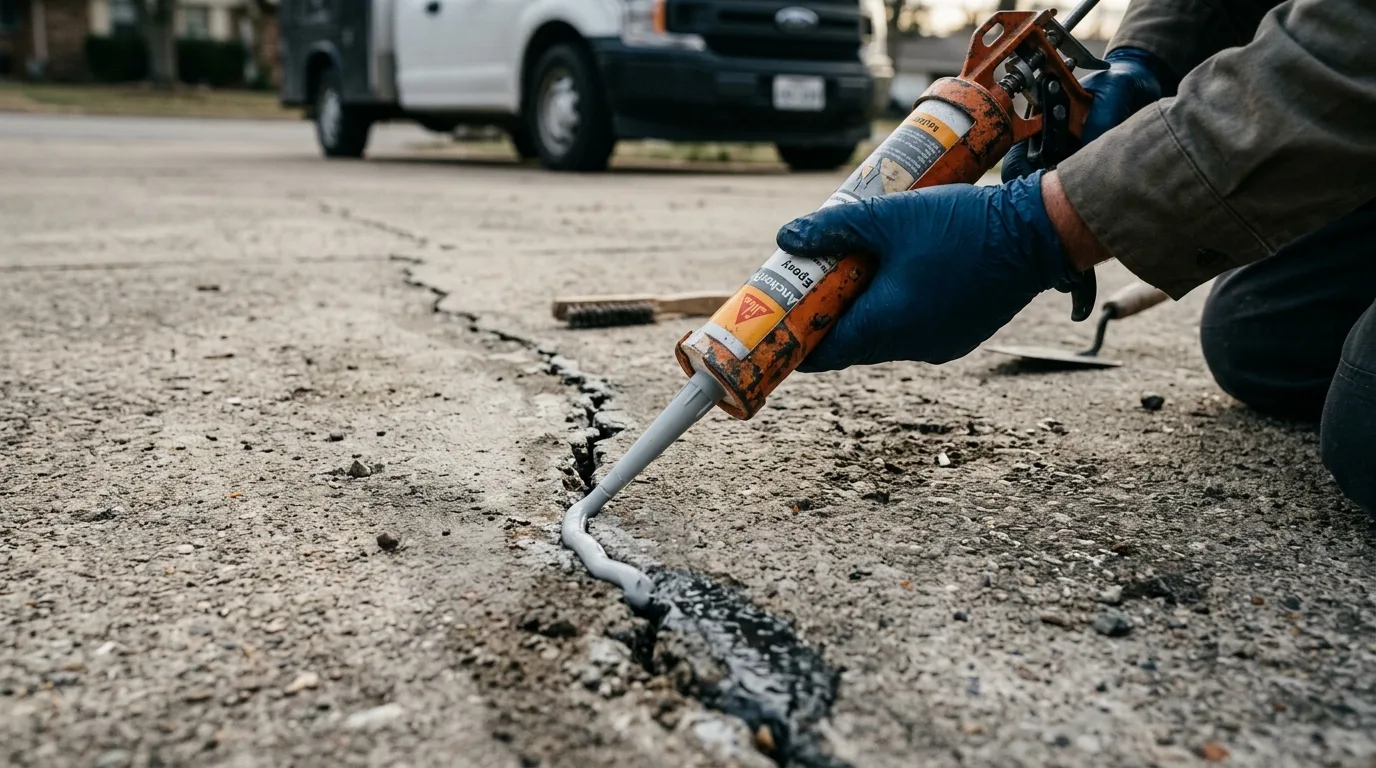
Every Dallas, GA homeowner with a cracked or deteriorating concrete driveway faces the same question: repair it or replace it? Getting the answer right saves thousands of dollars. Getting it wrong means either pouring money into a surface that will fail within a few years or unnecessarily replacing concrete that still had years of useful life. This guide gives you a clear framework for making that decision based on the actual condition of your slab.
In this post, we cover: the specific damage types that indicate repair is appropriate, the signs that point clearly to replacement, the cost comparison between options in Dallas, GA, and how Georgia’s red clay soil factors into the decision.
Free Concrete Assessment in Dallas, GA — Repair or Replace?
Dallas Concrete provides honest assessments with no pressure toward the more expensive option. Call (888) 376-0955.
Why This Decision Matters More in Paulding County
The repair vs. replace decision is complicated in Dallas, GA by Georgia’s red clay soil. A crack in a driveway here is rarely just a surface problem — it often reflects something happening in the sub-base. Paulding County’s expansive clay swells in spring, contracts in summer’s dry heat, and the concrete above it cracks under that ongoing movement. A repair that doesn’t address the sub-base or drainage cause of the crack will fail again within 2–5 years, costing repair money twice before an eventual full replacement.
The question isn’t just “how bad is the damage?” — it’s “what caused the damage, and can that cause be addressed without full replacement?” The answer determines which path makes economic sense.
Signs That Concrete Repair Is the Right Choice
Surface cracking without structural failure: Cracks that are hairline to 1/4 inch wide, limited to the top layer of the slab, and not accompanied by significant height differentials between sections can typically be repaired. Crack filling with polyurethane or epoxy stops water infiltration and prevents widening.
Localized spalling: Areas where the surface layer has broken away but the underlying concrete is solid. Polymer-modified mortar patch repairs restore the surface and provide lasting results when the cause (often lack of sealing or freeze-thaw cycling on an unsealed surface) is addressed going forward.
Isolated section failure: One or two slab sections have settled or cracked through, while the majority of the driveway remains sound. Removing and replacing the problem sections costs significantly less than full driveway replacement.
Age under 20 years with good structural integrity: Driveways in this condition in Savannah Lakes and Seven Hills are strong candidates for resurfacing overlay — a bonded thin-coat that restores appearance and seals the surface while preserving the sound structural slab below.
Sound sub-base confirmed: If probing reveals no voids beneath the slab and drainage is adequate, surface repairs will hold. If there are voids or drainage failures, those must be addressed as part of the repair scope.
Signs That Full Replacement Is the Right Choice
Widespread structural cracking: Cracks that cross the full depth of the slab across most of the driveway surface indicate the slab has lost structural integrity. Patching individual cracks in a failing slab is treating symptoms, not the disease.
Settlement exceeding 1 inch: When slab sections have dropped more than an inch relative to adjacent sections, the sub-base has either eroded, washed out, or shifted beyond what slab lifting can reliably correct. Full replacement with proper new base preparation is the sound economic choice.
Active sinkhole formation: Dallas, GA properties with buried construction debris or decomposing organic material beneath the lot can develop voids that collapse progressively under the concrete. This is a structural condition that requires removal, void remediation, and new installation — repair cannot address a sub-surface collapse.
Age over 30 years with general deterioration: Driveways installed before modern reinforcement standards were common are often better replaced than repaired. The cost of extensive repairs on a structurally marginal old slab approaches replacement cost while delivering a fraction of replacement’s longevity.
Drainage failure across the full driveway: When the entire slab has lost its drainage slope — either from ground settling or original poor installation — resurfacing doesn’t fix the grade. Full replacement allows proper re-grading.
Practical Uses: Cost Comparison for Dallas GA Homeowners
- Crack filling and sealing (isolated cracks): $200–$500. Appropriate for driveways with 1–5 cracks that haven’t been addressed and aren’t accompanied by sub-base problems.
- Partial slab section replacement: $800–$2,500 depending on number of sections. Best for driveways that have 1–3 problem sections with a sound majority slab.
- Full resurfacing overlay: $2–$4 per sq ft ($1,200–$2,400 for a 600 sq ft driveway). Appropriate for structurally sound slabs with widespread but superficial surface wear.
- Full replacement: $3,600–$6,600 all-in for a standard 600 sq ft driveway (including demo). Required when structural failure is widespread or the sub-base cannot support the existing slab.
The break-even analysis is straightforward: if the repair cost exceeds 50% of replacement cost, and the underlying cause cannot be fully addressed with the repair, replacement usually delivers better value per year of service life.
Get an Honest Repair vs Replace Assessment in Dallas
Dallas Concrete gives you a straight answer — we won't recommend replacement to sell a bigger job. Serving Paulding County. Call (888) 376-0955.
How Georgia Red Clay Changes the Analysis
In Dallas, GA, the sub-base assessment is the most important part of any repair vs. replace evaluation. A driveway on Paulding County’s red clay that cracked because the original base preparation was inadequate will crack again after any surface repair — because the root cause is still present. The repair question becomes: can we correct the drainage and base deficiency without full replacement?
Sometimes yes — partial excavation and base improvement in problem areas, combined with mudjacking to lift settled sections, can address clay-related failures effectively. Sometimes no — when clay movement has affected the full driveway uniformly, the only way to install an adequate base is to remove the existing slab entirely.
This is why a proper on-site assessment matters. Dallas Concrete evaluates every surface, probes for sub-base voids, assesses drainage, and gives homeowners an honest recommendation — not one based on which option generates more revenue. See our concrete repair services page for the full range of repair options we offer in Dallas and Paulding County.
Frequently Asked Questions
How do I know if my cracked driveway needs repair or replacement in Dallas GA?
The key indicators: How much of the driveway is cracked? (Less than 25%: likely repairable. More than 50%: lean toward replacement.) Are there height differentials between sections? (More than 1 inch: replacement territory.) Is there evidence of sub-base voids? (Hollow sound when tapped: assess for mudjacking or replacement.) Has the drainage failed? (Water pools on the slab: may require replacement to regrade.) See our concrete on Georgia red clay guide for more on how soil issues affect this decision.
Is it worth repairing a 20-year-old driveway in Paulding County?
It depends on the damage type and remaining structural integrity. A 20-year-old driveway in Dallas, GA with surface cracking, minor spalling, and no structural failure is a strong candidate for resurfacing overlay that can deliver another 10–15 years of service. A 20-year-old driveway with widespread structural cracking and sub-base settlement is likely approaching the end of its serviceable life, and the economics favor replacement. A professional assessment makes this determination accurately. Call Dallas Concrete for a free evaluation.
Can I DIY concrete crack repair on my Dallas GA driveway?
Simple hairline to 1/4 inch crack fills are within DIY capability using polyurethane crack filler available at home improvement stores. Clean the crack, apply backer rod for wider cracks, apply the filler, and tool it flat. For anything beyond isolated crack fills — spall repair, section replacement, or drainage correction — professional work delivers far better results and is worth the cost. Read our full concrete repair guide for Dallas, GA for what professional repair involves.
Repair or Replace? Get a Free Honest Assessment in Dallas.
Dallas Concrete evaluates your driveway and tells you the truth. Serving Dallas, Hiram, Douglasville, and all of Paulding County. Call (888) 376-0955.
Related: