Commercial Concrete Contractors in Dallas GA: What Businesses Need
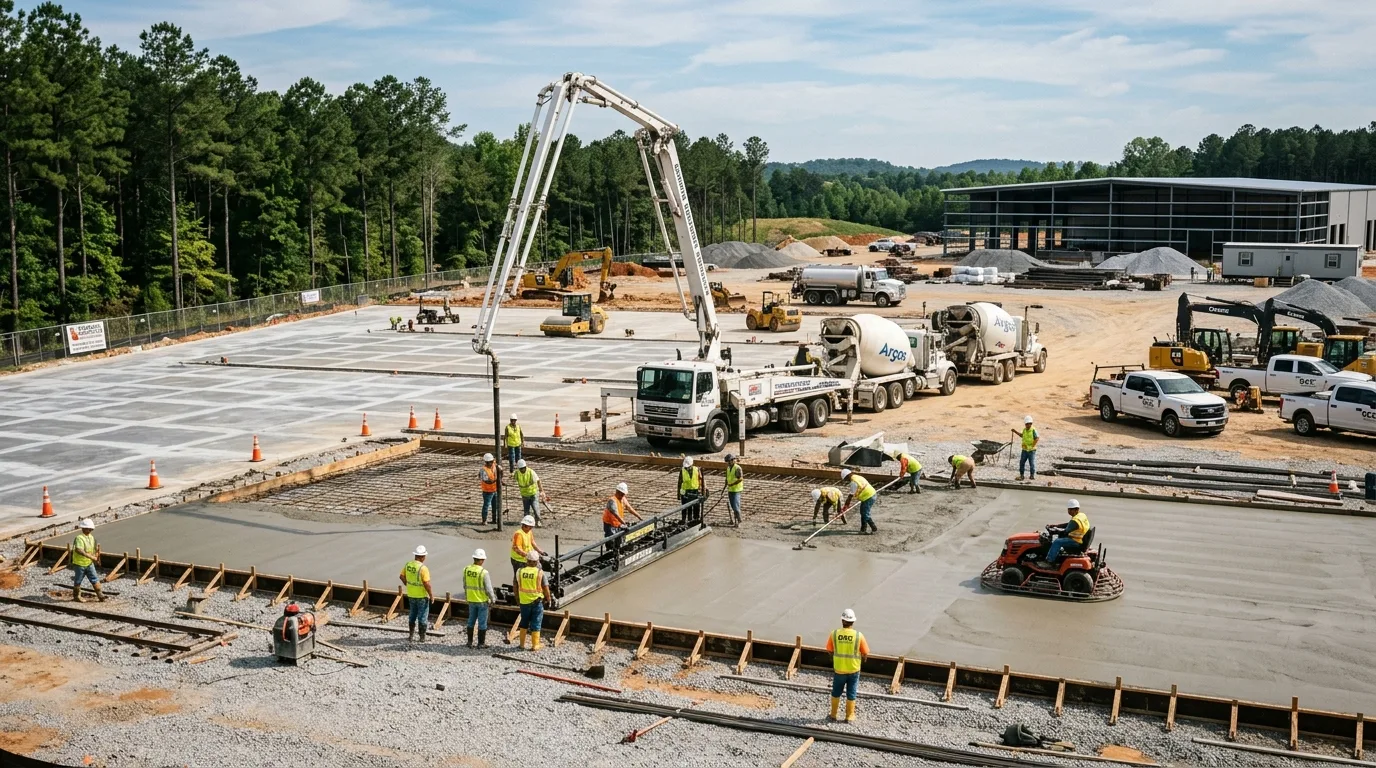
Commercial concrete projects in Dallas, GA have different requirements than residential work — thicker slabs, higher reinforcement density, more complex permitting, and drainage designs that handle large impervious areas. Business owners who treat a commercial pour like a residential one end up with concrete that fails under commercial traffic loads within 5–10 years. This guide explains what Dallas, GA businesses need to know before starting any commercial concrete project in Paulding County.
In this post, we cover: how commercial concrete specs differ from residential, common commercial concrete projects in Dallas and Paulding County, permit requirements for commercial work, and how to choose a commercial concrete contractor.
Commercial Concrete Estimates for Dallas, GA Businesses
Dallas Concrete provides commercial concrete services for businesses throughout Paulding County. Call (888) 376-0955.
Why Commercial Concrete Is Different in Dallas GA
The fundamental difference is load. A residential driveway carries passenger vehicles — typically 3,500–6,000 lbs. A commercial parking lot carries delivery trucks, service vehicles, and customer traffic continuously. A loading dock takes repetitive wheel loads from heavy trucks that can exceed 80,000 lbs. Concrete designed for passenger vehicles will fail under those commercial loads if the slab thickness, reinforcement, and sub-base aren’t specified for the actual use.
Commercial concrete in Dallas, GA also faces Paulding County’s red clay soil challenge at a higher scale: large commercial slabs collect more runoff, put more point loads on the sub-base, and have larger joints that require careful design and maintenance. Businesses near Dallas’s commercial corridors and industrial areas — and increasingly in the Douglasville market — know that poorly specified commercial concrete is a recurring maintenance cost that can be avoided with proper upfront specification.
Common Commercial Concrete Projects in Dallas GA
Parking lots: New construction or replacement of deteriorated commercial parking. Requires 5–6 inch slab thickness minimum, rebar grid (not just mesh), properly designed joints, and drainage to manage large paved-area runoff.
Loading docks and truck aprons: The highest-load application in commercial concrete. Heavy trucks back up repeatedly at the same locations, concentrating load on the dock apron. Standard spec is 6–8 inch slab with heavy rebar reinforcement and a carefully designed joint pattern that prevents corner breaks.
Concrete pavement for commercial drives: Access roads, drive-throughs, and circulation lanes for retail and service facilities. Designed for the specific vehicle mix — all passenger vehicles, or mixed passenger/commercial.
ADA-compliant pathways and ramps: Required by law for commercial properties and new construction. Slope, texture, and width must meet current ADA standards. Concrete is the standard material for durable, compliant commercial pathways.
Commercial flatwork for new construction: Site concrete for retail, industrial, and institutional development in Paulding County — curbing, aprons, walks, and utility pads.
Concrete repair for commercial facilities: Parking lot crack repair, joint re-sealing, and surface patching to extend the service life of existing commercial concrete pavement.
Practical Uses: Commercial Concrete Applications by Business Type
- Retail and restaurant businesses: Standard parking lot concrete, drive-through aprons, entry walks, and ADA pathways. Key requirement: ADA compliance from day one, not retrofitted later.
- Industrial and warehouse facilities: Heavy-duty slabs, loading dock aprons, and forklift-grade interior concrete with tight flatness tolerances.
- Churches and institutional properties: Parking lots designed for weekly peak loads and occasional overflow events, plus ADA-compliant pathways throughout the property.
- Professional office buildings: Standard commercial parking, attractive entry walks, and potentially decorative stamped concrete at the main entry to match the building’s character.
- Gas stations and auto service businesses: Concrete designed for fuel spill resistance and heavy vehicle loads — standard concrete with proper sealers for chemical resistance.
Commercial Concrete Permit Requirements in Dallas GA
Commercial concrete in Dallas, GA requires building permits and inspections — and typically involves more documentation than residential work. The City of Dallas mandates a pre-pour inspection for all concrete slabs. Commercial projects may additionally require:
- Site plan review: Large commercial paving projects often require a grading and drainage plan submitted with the permit application.
- ADA compliance documentation: Projects that include public pathways must demonstrate ADA compliance in the permit drawings.
- Zoning and land use review: Some commercial uses require additional review before construction permits are issued.
Dallas Concrete manages all permit coordination and inspection scheduling for commercial projects. Call 770-443-8110 ext. 1203 to reach Bureau Veritas for inspection scheduling. See our Dallas, GA concrete permit guide for the general permit process.
Commercial Concrete for Dallas GA Businesses — Free Estimates
Dallas Concrete handles permits, specs, and installation for Paulding County commercial projects. Call (888) 376-0955.
What Affects Commercial Concrete Cost in Dallas GA
Commercial concrete in Dallas, GA is priced by project scope rather than a simple per-square-foot rate, but general ranges help with budgeting:
Standard commercial flatwork (parking, walks): $5–$8 per sq ft for typical commercial applications.
Heavy-duty loading/industrial: $6–$12 per sq ft for thicker, more heavily reinforced slabs.
Key cost drivers for Paulding County commercial projects:
- Slab thickness: Commercial slabs are 5–8 inches vs. 4 inches residential — this directly increases material cost.
- Reinforcement density: Commercial rebar grids use more steel than residential mesh.
- Sub-base depth: Paulding County’s clay soil requires 6–8 inches of compacted aggregate for commercial loads — more than residential.
- Joint design: More closely spaced joints in commercial concrete require more saw cutting or tooling labor.
- Drainage design: Large commercial surfaces collect significant runoff — proper drainage design adds engineering cost but prevents expensive repairs.
- Project phasing: Maintaining business operations during construction adds mobilization cost but is often necessary.
How to Choose a Commercial Concrete Contractor in Dallas GA
Commercial concrete requires a contractor with verified commercial project experience — not just residential work at scale. Ask any commercial bidder:
“What’s your largest completed commercial project in Paulding County or the northwest Atlanta area?” A contractor with no commercial track record is not appropriate for a commercial loading dock or large parking lot project.
“How do you spec concrete mix and thickness for commercial vehicle loads?” A correct answer demonstrates knowledge of load-bearing requirements and mix design for commercial applications. A vague answer suggesting the same spec as residential work is a red flag.
“Do you coordinate commercial permits and ADA compliance documentation?” Legitimate commercial contractors manage this as part of their service. Contractors who expect the property owner to manage permitting for commercial projects are not set up for commercial work.
Verify insurance adequacy: Commercial projects require higher liability limits than residential — confirm the contractor’s insurance is adequate for the project value.
Frequently Asked Questions
How long does a commercial concrete parking lot last in Dallas GA?
A properly specified commercial parking lot in Dallas, GA lasts 20–30 years with regular maintenance — joint re-sealing every 3–5 years, crack repair as needed, and sealing every 5–7 years. The critical determinant of longevity is the original specification: slab thickness appropriate for the actual vehicle mix, adequate sub-base depth for Paulding County’s clay, and a well-designed joint pattern. Parking lots that fail in 10 years are almost always under-specified for the load they’re carrying.
Do I need a permit for concrete repair at my Dallas GA commercial property?
Surface repairs — crack filling, joint re-sealing, and patching — typically don’t require permits. Section replacement and significant structural work does. Any project involving new concrete placement at a commercial property in Dallas should be confirmed with the City before starting. Dallas Concrete advises on permit requirements during the estimate process for all commercial repair and replacement projects.
How can I extend the life of my existing commercial concrete in Dallas GA?
Annual inspection, timely joint re-sealing, prompt crack filling, and strategic sealing every 3–5 years are the highest-return maintenance activities for commercial concrete in Paulding County. Water infiltration through open joints and unsealed cracks is the primary mechanism that destroys commercial concrete pavement — addressing it routinely prevents the accelerating deterioration cycle. Contact Dallas Concrete for a commercial pavement assessment and maintenance plan for your Dallas area property.
Dallas Concrete — Commercial Concrete for Paulding County Businesses
We serve businesses in Dallas, Kennesaw, Douglasville, and throughout Paulding County with commercial concrete built to last. Call (888) 376-0955.
Related: